


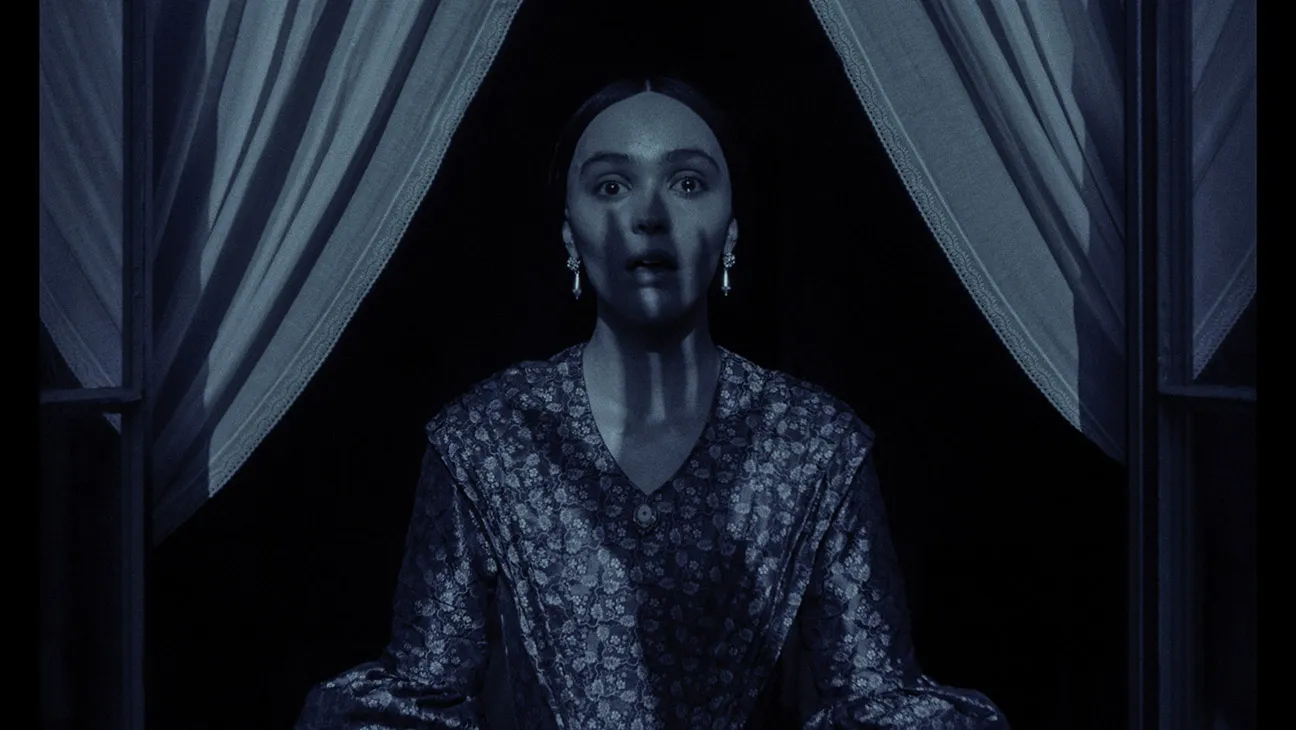
The soil of Transylvania does not merely hold the dead; it breathes. It exhales an ancient rot that seeps into the lives of the living, carried by wind thick with the scent of blood and decay. In Nosferatu (2024), darkness is not simply the absence of light; it is a physical presence, pressing against windows and minds alike.
The film does not merely depict a haunting; it exalts a predatory obsession that transcends time, geography, and the human soul. In this world, hope is fragile, and the only certainty is the skeletal hand reaching out from the shadows of your own bedroom.
At the center of the narrative is a marriage strained not just by distance, but by destiny. Thomas Hutter, an ambitious real estate agent, leaves the quiet town of Wisburg for the Carpathian Mountains to finalize a lucrative land deal. He believes the journey will secure comfort for his wife, Ellen. Instead, the contract becomes a death warrant. His client, Count Orlok, is no ordinary nobleman, but a manifestation of cosmic hunger.
The film quickly abandons mundane concerns to reveal a far more unsettling truth: Orlok and Ellen share a pre-existing psychic bond, one that predates Thomas’s journey and turns the Hutter household into a beacon for ancient evil. As Thomas becomes trapped in a castle that seems to defy physical laws, the narrative shifts its focus. Orlok’s slow voyage across the sea mirrors Ellen’s psychological unraveling back home, binding their fates together across distance and decay.
The final act unfolds as a race against the sun, where survival hinges not on strength or knowledge, but sacrifice. Some legends cannot be outrun. They must be invited in.
✅ What Works
- Folklore-Driven Worldbuilding: The film draws from darker strands of Eastern European vampire lore, including the Solomonar mythos, grounding the horror in occult tradition rather than romantic fantasy.
- The Plague as Antagonist: The Black Death is not background texture but an active, suffocating force. Its presence erases social order and blurs the line between supernatural terror and historical reality.
- A Female-Centered Narrative: Ellen emerges as the emotional and moral core. Her evolution from haunted observer to self-aware martyr adds depth and tragic agency rarely afforded in classic adaptations.
- Patient, Atmospheric Pacing: The film understands that dread thrives in silence. Rats, shadows, and the creak of ships do as much storytelling as dialogue, allowing tension to ferment slowly.
- Psychological Subtext: Orlok functions as both monster and metaphor, embodying repressed desire and the suffocating constraints of 19th-century morality.
❌ Where It Falls Short
- Familiar Story Beats: The film adheres closely to the traditional Nosferatu/Dracula framework, making its broad narrative trajectory predictable for genre veterans.
- A Fading Protagonist: Once Thomas escapes Orlok’s castle, his journey loses momentum, struggling to compete with the far more compelling psychological battle between Ellen and the Count.
- Over-Explanation: At times, the film makes its psychic and sexual subtext too explicit, sacrificing the eerie ambiguity that gives earlier scenes their power.
- A Distracting Climax: A secondary “vampire hunt” subplot delays the inevitable resolution, briefly draining urgency from the final stretch.
⚖️ Final Verdict: 4/5
Nosferatu (2024) is a towering work of Gothic horror that rejects modern jump-scare excess in favor of slow, suffocating dread. Though its story follows a well-worn path, the density of its atmosphere, its treatment of plague as existential terror, and its tragic focus on desire and sacrifice make it feel freshly infected.
This is not a film that wants to scare you. Rather, it aims to linger, to rot in your thoughts long after the screen fades to black. Grim, tragic, and disturbingly beautiful, Nosferatu reminds us why the dark still holds power over the human imagination.
