


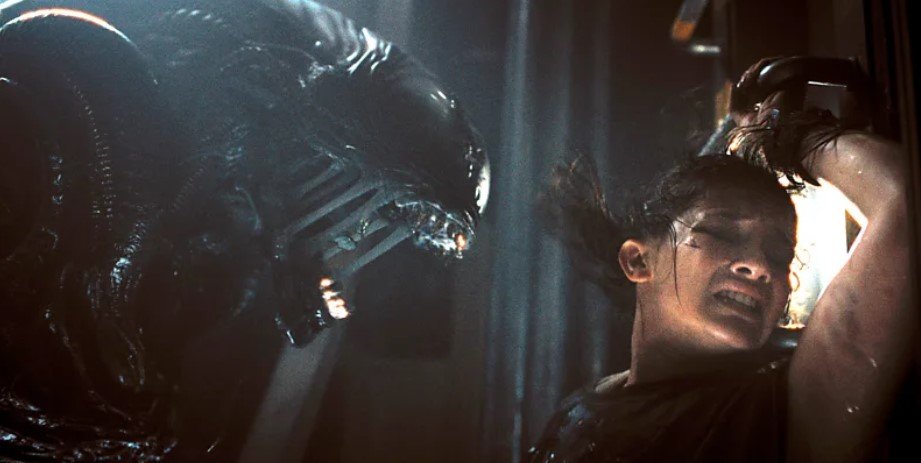
The Alien franchise has spent decades expanding its mythology, but Fede Álvarez’s Alien: Romulus brings the series back to something much simpler: a group of desperate young people trapped in a place where almost everything wants them dead. Set between Alien and Aliens, the film follows a crew of scavengers who enter an abandoned Weyland-Yutani space station hoping to recover equipment that could help them escape their bleak lives. Instead, they uncover the remains of a biological nightmare that turns their escape plan into a fight for survival.
The station, divided between the Romulus and Remus modules, becomes the perfect setting for the film’s horror. Its dark corridors, abandoned laboratories, failing systems, and industrial machinery create a constant feeling of confinement. Álvarez understands that the Alien creature is most effective when it is not fully visible, allowing shadows, movement, and silence to do much of the work before the horror finally reveals itself.
The film also returns to one of the franchise’s most enduring ideas: corporate ambition without ethical limits. Weyland-Yutani’s obsession with exploiting the Xenomorph remains at the center of the story, while synthetic technology and experimental compounds introduce new consequences for those willing to treat living organisms as scientific resources. The result is a survival story that combines creature horror, body horror, and the familiar anxiety of being trapped somewhere humanity was never meant to control.
What Works ✅
Tactile, Atmospheric Horror: Álvarez gives Alien: Romulus a physical quality that makes the station feel genuinely lived-in and dangerous. The creature effects, practical sets, facehuggers, machinery, and grimy industrial environments create a world that feels connected to the original films without simply recreating them.
The attention to physical detail also makes the horror more immediate. Every corridor feels functional, every piece of equipment feels capable of malfunctioning, and every dark corner seems capable of hiding something.
Strong Suspense Sequences: The film is at its best when it slows down and lets the situation become increasingly impossible. One standout sequence involving zero gravity and Xenomorph blood turns the creature’s most famous biological feature into part of the environment itself, forcing the characters to think carefully about every movement.
These sequences demonstrate Álvarez’s understanding of suspense. The danger does not always come from the creature attacking directly. Sometimes it comes from the characters realizing that the environment around them has become just as deadly.
Rain and Andy’s Relationship: Cailee Spaeny gives Rain a grounded performance that keeps the story emotionally connected to the characters rather than allowing the film to become a simple creature feature. Her relationship with Andy, played by David Jonsson, provides the film with its strongest emotional thread.
Andy is particularly interesting because his role as a synthetic creates uncertainty around his loyalty and decision-making. Jonsson brings enough vulnerability and complexity to the character that his evolving relationship with Rain becomes almost as compelling as the Xenomorph threat.
Where It Falls Short ❌
Too Much Franchise Nostalgia: Alien: Romulus sometimes struggles to separate homage from repetition. The film contains numerous references to earlier entries, some of which feel naturally integrated while others seem designed primarily to remind longtime fans of what came before.
This becomes particularly distracting when the film revisits familiar dialogue, imagery, and franchise mythology instead of trusting its own material. The result is a movie that occasionally feels caught between being a new Alien story and a collection of memories from the old ones.
Supporting Characters Feel Familiar: Outside Rain and Andy, several members of the crew are not given enough personality to make their eventual fates particularly affecting. Their roles often resemble familiar horror archetypes, leaving the central pair to carry most of the emotional weight.
That does not make the ensemble ineffective, but it does make parts of the film feel predictable. Once the group enters the station, it becomes fairly easy to anticipate who will survive and who will not.
⚖️ Final Verdict: 3.5/5
Alien: Romulus is a tense and atmospheric return to the survival horror foundations of the franchise. Fede Álvarez delivers impressive creature work, inventive suspense sequences, and a strong central relationship between Rain and Andy, even if the film occasionally relies too heavily on nostalgia.
Its supporting characters could have used more depth, and some of its callbacks feel more distracting than meaningful. Still, the combination of practical effects, claustrophobic atmosphere, and relentless creature horror makes Alien: Romulus an effective reminder of why the Xenomorph remains one of cinema’s most enduring nightmares.
