


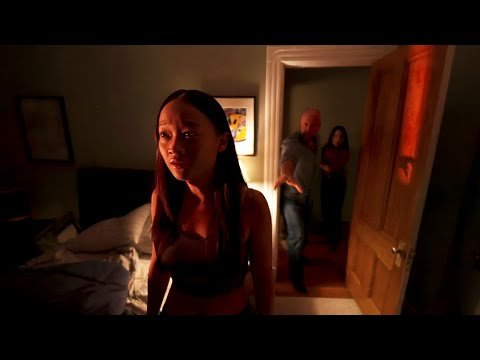
What happens when the camera itself becomes the ghost? Steven Soderbergh’s Presence answers that question by turning the lens into an unseen presence inside a suburban home. Shot almost entirely from the entity’s perspective, the film places the audience in the position of a silent observer who drifts through rooms, follows family members, and watches their private moments without ever being able to intervene.
The story follows the Payne family as they settle into a new home while dealing with problems that threaten to pull them apart. Rebekah is a controlling, ambitious mother caught up in corporate legal troubles, while her husband Chris is more easygoing but increasingly frustrated by the tension in the household. Their teenage son, Tyler, is a competitive swimmer who gets much of his mother’s attention, leaving their daughter, Chloe, increasingly isolated.
Chloe is still struggling with the sudden death of her best friend and feels disconnected from the rest of her family. She is also the only member of the household who seems to sense the presence inside the house. What begins as an unsettling supernatural connection gradually becomes something more protective as the entity grows attached to Chloe.
The film takes a darker turn when Chloe becomes involved with Oliver, a charming friend of her brother who quickly earns her parents’ trust. While the adults around Chloe see Oliver as polite and harmless, the entity recognizes something far more disturbing beneath his friendly exterior. The horror then shifts from the supernatural to something much more immediate as the ghost tries to protect Chloe despite having no obvious way to communicate with her.
What Works ✅
First-Person Cinematography: Soderbergh, who also operates the camera, gives Presence its most distinctive feature. The camera moves through the house as though it has a mind of its own, drifting between rooms, lingering on characters, and occasionally reacting to what it sees.
This perspective makes ordinary moments feel strangely uncomfortable. A family dinner, an argument, or someone sleeping becomes more intimate because the audience is not simply watching from outside. We are placed inside the house with the family, seeing events from the entity’s perspective.
A Fresh Take on the Haunted House: Screenwriter David Koepp cleverly turns the usual haunted-house formula upside down. The supernatural presence is not the threat. Instead, it becomes the character most concerned with protecting Chloe.
That reversal gives the film an interesting moral perspective. The entity may be mysterious, but its intentions gradually become clearer, while the people around Chloe reveal their own selfishness, dishonesty, and inability to recognize what she is going through.
Strong, Grounded Performances: Callina Liang gives the film an emotional center as Chloe, portraying a teenager who feels increasingly disconnected from the people around her. Her performance makes Chloe’s grief and isolation feel believable without becoming overly dramatic.
Lucy Liu is equally effective as Rebekah, whose determination to maintain control over her family gradually exposes the cracks in her relationship with Chloe. The performances help keep the film grounded even when its supernatural premise becomes increasingly unusual.
Suspense Through Helplessness: The film finds an effective source of tension in the entity’s inability to communicate. It can see what is happening, but it cannot simply warn Chloe or physically stop a threat.
That limitation makes the final stretch especially tense. The audience understands the danger before the characters do, creating suspense from the simple frustration of watching something unfold while knowing there may be no way to intervene.
Where It Falls Short ❌
Some Domestic Subplots Feel Underdeveloped: The film introduces several elements of the family’s personal lives, including Rebekah’s corporate legal problems, but not all of them feel equally connected to the main story.
These details help establish the family’s dysfunction, yet some receive more attention than their eventual payoff justifies. The result is a few narrative threads that feel more like background information than essential parts of the story.
The Middle Section Moves Slowly: The housebound perspective gives Presence its identity, but it also creates some pacing problems. The camera spends a significant amount of time moving through familiar rooms and observing everyday family conflicts before the central threat fully develops.
The slow pace works for much of the film because it allows the tension to build gradually. However, the middle section occasionally feels repetitive, particularly when the family drama takes over for extended periods.
The Final Act Moves Too Quickly: After spending much of its runtime building a quiet, observational atmosphere, Presence suddenly becomes much more intense in its final act. The escalation is effective, but it happens quickly enough that some character and supernatural elements receive less attention than they deserve.
The climax delivers the tension the film has been building toward, although the transition could have been smoother.
⚖️ Final Verdict: 4/5
Presence is an inventive take on the haunted-house movie that finds a surprisingly effective way to make its camera part of the story. Soderbergh’s unusual perspective creates an intimate sense of unease, while David Koepp’s screenplay shifts the source of the horror from the supernatural to the dangers hiding in plain sight.
The uneven pacing and underdeveloped subplots prevent it from being completely satisfying, but the central concept is strong enough to carry the film. By making the ghost an observer rather than the threat, Presence turns a familiar horror setup into a tense story about grief, family dysfunction, and the frustration of wanting to protect someone when you cannot simply tell them what is coming.
