


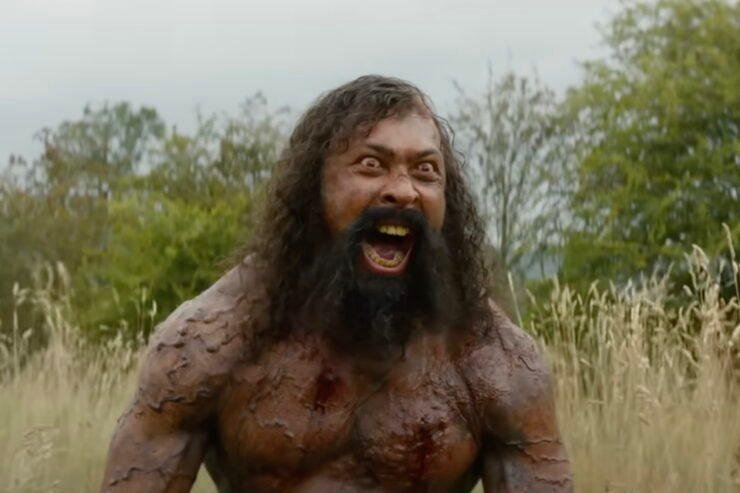
The apocalypse of the Rage Virus has always been as much a study of human behavior as it is a story about biological survival. With 28 Years Later: The Bone Temple, director Nia DaCosta pushes that idea even further, shifting the franchise’s terror away from the infected and toward the calculated cruelty of the people who survived them.
Picking up where 28 Years Later left off, the film takes Spike from a frightened boy running for his life to a captive caught in the hands of a far more deliberate threat: the Jimmys. Led by the charismatic and deeply unhinged Sir Jimmy Crystal, this sadistic, Satan-worshipping cult has transformed the British countryside into a nightmare built around ritual, violence, and control.
For Spike, survival is no longer simply about outrunning infected bodies. It becomes a psychological battle against people who have willingly embraced depravity. That shift gives The Bone Temple a different kind of horror from its predecessor. The infected remain terrifying, but the film increasingly treats them as a force of nature.
What Works ✅
The Jimmys Are More Terrifying Than the Infected:
Jack O’Connell’s Sir Jimmy is the film’s most unsettling creation. He brings a volatile mixture of charisma, madness, and cruelty to the character, making Sir Jimmy frightening precisely because he isn’t simply a conventional monster.
The Jimmys introduce a distinctly cultish form of horror into the 28 Years Later universe. Their rituals and worldview make the collapse of civilization feel like an opportunity rather than a tragedy. They have taken the freedom created by societal collapse and used it to construct their own brutal order.
That makes them an effective evolution of the franchise’s central idea. The Rage Virus can turn people into monsters, but The Bone Temple asks what happens when ordinary people decide to become monsters themselves.
Dr. Kelson and Samson Give the Film Its Heart:
The film’s most unexpected strength lies in the strange relationship between Dr. Ian Kelson and Samson, an Alpha who has moved beyond simple rage. Ralph Fiennes gives Kelson a weary, eccentric humanity that provides a welcome contrast to the brutality surrounding him. His work at the titular Bone Temple creates an unusual sanctuary within the apocalypse, one where curiosity and compassion still have some value.
His relationship with Samson is particularly effective because it complicates the franchise’s understanding of the infected. Rather than treating them exclusively as threats to be eliminated, the film begins asking whether something recognizable as humanity can still exist within them.
The result is one of the film’s most emotionally compelling threads, blending strange humor with genuine melancholy.
A Bold Evolution of the Franchise
Nia DaCosta does not simply repeat the survival formula established by the earlier films. Instead, The Bone Temple expands the mythology and pushes the franchise into an untapped territory for Zombie horror. The film introduces an idea that could fundamentally change everything that came before it: the possibility of a cure.
When Samson moves beyond pure rage and manages to utter a coherent word, the moment carries enormous implications. It suggests that the Rage Virus may not necessarily represent the destruction of human consciousness. If infected individuals can evolve, communicate, and potentially recover, then the franchise’s understanding of the virus suddenly becomes much more complicated.
Where It Falls Short ❌
Spike’s Agency Gets Lost:
For a film that continues Spike’s story, The Bone Temple occasionally pushes him too far into the background. Alfie Williams remains compelling in the role, but Spike can feel like a passenger as the film becomes increasingly occupied with the Jimmys, Kelson, Samson, and the larger mythology surrounding the Bone Temple.
The Tone Can Be Jarring:
The film’s willingness to move between different forms of horror is both a strength and a weakness. The Jimmys bring some of the film’s darkest and most disturbing material, while the Bone Temple offers something almost melancholic and strangely tender. The contrast between ritualistic brutality and the eccentric warmth surrounding Kelson and Samson is intentional, but the transitions are not always seamless.
⚖️ Final Verdict: 4/5
28 Years Later: The Bone Temple is an uncompromising sequel that refuses to let the 28 Years Later franchise settle into familiar territory. Nia DaCosta takes the series beyond the mechanics of survival into a darker examination of cult psychology, human cruelty, and the possibility that the infected may be capable of recovering themselves.
Its most effective horror comes from what people could become when the structures of civilization disappear. At the same time, the relationship between Dr. Kelson and Samson gives the film an unexpected emotional center and introduces a potentially transformative new direction for the franchise.
The film expands the mythology, complicates the meaning of infection, and leaves the door open to a future where the apocalypse might not be entirely irreversible.
