


By Paul Michael Durivage
Spoilers for It Follows, including its ending.
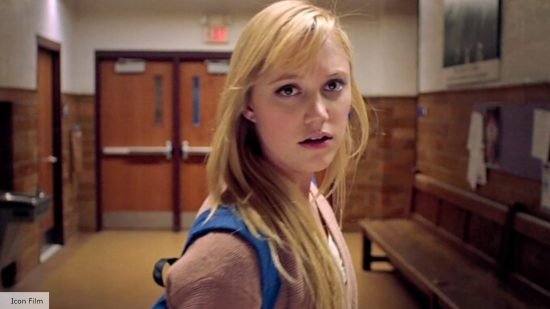
An old woman is walking toward Jay’s classroom. In another film, she might be a visitor looking for an office. Here, her slow approach is enough to send Jay out of her seat. The people around her keep going about their day. They have no reason to watch the woman, and Jay has no reason to stop.
By this point in It Follows, a person walking through the background has become a problem we have to solve. Where are they going? Have they changed direction? Will they keep coming if Jay moves? David Robert Mitchell makes us study an ordinary action until looking away begins to feel like neglect.
The film starts teaching that habit before we meet Jay. A young woman named Annie runs from her house into a suburban street, frightened by something we cannot see. A neighbor offers help. Her father wants to know what she is doing. From their position, she appears to be the source of the disturbance. From hers, everyone else is failing to react to it.
When Every Approaching Figure Becomes a Threat

Annie drives away, and the opening eventually shows us what has happened to her body. We know the pursuit has consequences before we understand its rules. Later, when Jay is told that something will follow her, walking pace sounds almost manageable. The opening prevents that thought from becoming much comfort. We have already watched a young woman get into a car and put distance behind her.
The classroom sequence makes the problem clearer. There is time to see the woman approaching. That time gives Jay options, but it also gives her a worsening obligation to choose one. Staying in class becomes a decision. Leaving makes her fear visible to people who cannot see its cause. She steps out into the corridor and finds that the approach has continued.
This is a particularly effective use of slowness. A fast attacker can overwhelm a character before there is much to decide. A slow one allows her to wonder whether she is reading the situation correctly. Meanwhile, the distance keeps shrinking. The uncertainty takes place inside an action we can follow, so the scene can remain patient without feeling idle.
Mitchell described the underlying nightmare in a Film at Lincoln Center interview. As a child, he dreamed of a monster that looked like different people and kept approaching while those around him failed to notice. He could get away from it. What stayed with him was the feeling that it was always there.
That feeling changes the spaces Jay enters. A doorway ordinarily helps divide one place from another. Once she is being followed, it also becomes the route by which the next encounter might arrive. A room full of friends can offer company while leaving her watching the entrance. The practical problem survives the change of address.
Why Having Someone Beside You Is Not Enough

The tall man who appears in the bedroom doorway makes that vulnerability horribly immediate. His size is startling, but so is the loss of distance. The film has trained us to look for someone approaching from far away. Now a body almost fills an opening close to Jay. There is very little space left in which to make the next decision.
Mitchell told Fangoria that he wanted his characters to feel like friends who had become a temporary family. Their presence matters because it gives Jay something worth remaining with. If companionship offered nothing, the story could become a simple exercise in driving farther away. Instead, she needs other people, and being near them introduces difficulties that speed cannot solve.
They can care about her without seeing what she sees. They can accompany her without being able to watch every possible approach on her behalf. That leaves a cruel imbalance in the group. The person who most needs a break is also the person who must keep recognizing the danger and telling everyone else where it is.
The film makes passing the threat onward possible through sex, which complicates the apparent usefulness of an escape. Hugh’s explanation gives Jay a way to become less immediately exposed by making somebody else the next target. That person’s death would return the danger to her. Distance now has a human cost as well as a physical measurement. Somebody must be closer to it.
This keeps the relationship between Jay and Paul uneasy even when it becomes tender. His willingness to stay beside her has meaning. So does what staying might expose him to. In the same Fangoria interview, Mitchell resisted reducing the premise to a straightforward punishment for sex. Intimacy in the film can offer temporary relief as well as danger. Neither possibility makes the other disappear.
The final walk leaves that tension in an ordinary neighborhood. Jay and Paul hold hands. Someone walks behind them. The figure is far enough away to be an unremarkable stranger, but the film has spent too long teaching us to inspect an approach for us to dismiss it casually.
We can see the couple’s closeness and still keep checking the background. Their decision to be together does not require the image to certify that everything is safe. It gives us two people continuing with their lives while the distance behind them remains open to question. Even as they walk away, we are still looking after them.
About the author
Paul Michael Durivage is a Michigan author whose work includes supernatural horror and workplace satire. His books and author information are at https://www.paulmichaeldurivage.com/books.
