


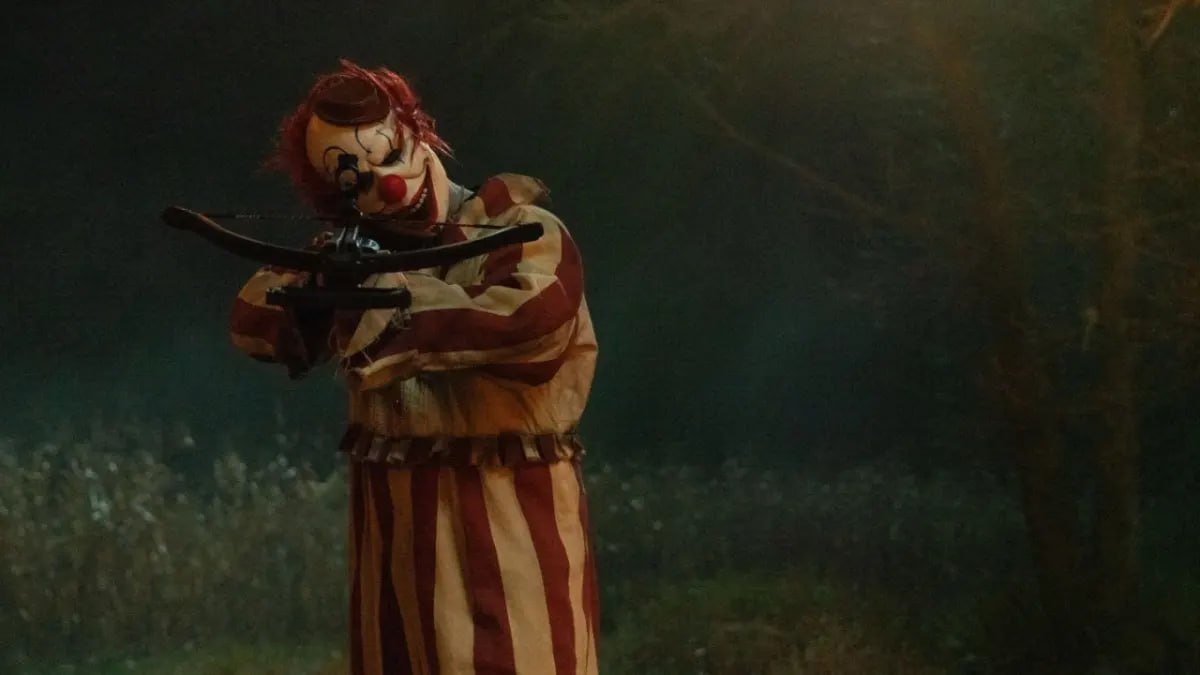
Small-town complacency has rarely tasted as bitter, or looked as violently garish, as it does in Eli Craig’s Clown in a Cornfield. Adapted from Adam Cesare’s acclaimed novel, the film trades cosmic dread for a blood-soaked dissection of generational warfare, toxic nostalgia, and the resentment simmering beneath the surface of small-town America.
The story drops Quinn Maybrook into Kettle Springs, a dying Midwestern town still lingering in the shadow of a burned-out corn syrup factory. Quinn arrives with her grieving father, hoping for a fresh start, only to discover that Kettle Springs is anything but peaceful. Beneath its quiet streets is a community divided by an increasingly bitter conflict between young people desperate to move forward and older residents determined to preserve a version of the past they believe is slipping away.
That tension eventually erupts when Frendo, the town’s grinning, bygone mascot, emerges from the cornfields. What initially looks like a supernatural slasher quickly reveals itself to be something much more human. The killer behind the greasepaint is not a demon or an otherworldly entity, but an ideological zealot using nostalgia as a weapon against the town’s younger generation. As the cornfields become a claustrophobic maze of violence, Quinn and her surviving classmates are forced to confront the horrifying reality that the adults around them are willing to destroy them in the name of preserving the past.
What Works ✅
Subversive Social Commentary
The film’s smartest idea is the way it turns Frendo into a symbol of toxic nostalgia. There is something inherently disturbing about a cheerful Americana mascot becoming the face of a campaign of violence, and Eli Craig makes that contradiction central to the film’s identity.
Frendo represents a past that refuses to die, even as those living in the present have moved beyond it. The film’s generational conflict is deliberately exaggerated, but that exaggeration gives its satire plenty of bite. Tradition, community pride, and nostalgia become increasingly sinister when they are used to justify controlling or eliminating anyone who does not fit the preferred image of the town. The result is a slasher that understands exactly how absurd its central conflict is while still taking its underlying anxieties seriously.
Relentless, Kinetic Pacing
Once Frendo emerges, Clown in a Cornfield rarely gives the audience time to breathe. Craig turns the wide-open farmland into an unexpectedly effective horror environment, using the cornfields, isolated properties, and sprawling rural landscape to create the feeling of a trap that keeps getting smaller. The film also understands the value of momentum. Kill sequences arrive with energy, while the dark humor prevents the violence from becoming monotonous. Rather than allowing the premise to become weighed down by its social commentary, Craig keeps the film moving toward its next chase, confrontation, or gruesome surprise.
Quinn’s Final Girl Evolution
Katie Douglas gives the film its emotional center as Quinn. What makes her performance work is that Quinn is not immediately presented as a perfectly prepared survivor. She begins as an outsider struggling to adjust to a new town while dealing with the emotional weight of her family’s circumstances.
Her transformation therefore carries genuine weight. As the violence escalates, Quinn becomes increasingly resourceful and determined without losing the vulnerability that made her compelling in the first place. By the time the film reaches its violent final stretch, her evolution from isolated newcomer to hardened survivor gives the carnage a much-needed emotional anchor.
Where It Falls Short ❌
The Mystery Is Easy to Crack
The film’s thematic ideas are more interesting than its central mystery. Horror fans familiar with the genre will probably identify the person behind Frendo’s mask well before the film confirms it.
The clues are not particularly subtle, and the screenplay does not provide enough genuine ambiguity to make the eventual revelation especially surprising. The mystery works as a vehicle for the film’s larger themes, but it is unlikely to leave experienced slasher viewers guessing for long.
Supporting Characters Lean Into Stereotypes
The film’s teenage ensemble occasionally falls victim to the same broad characterization that its satire embraces. Several of the younger characters are intentionally obnoxious, which makes sense within the film’s generational conflict, but it also makes some of the early deaths feel less consequential.
The constant rush toward the next set piece leaves little room to develop the supporting cast beyond their archetypes. Quinn is given enough depth to carry the emotional story, but the ensemble around her is less consistently memorable.
⚖️Final Verdict: 2.5/5
Clown in a Cornfield is a nasty, brightly colored, and fiercely entertaining neo-slasher that understands exactly how to turn a ridiculous premise into something surprisingly pointed. Frendo may look like a relic of a happier America, but the film uses that familiar grin to expose something considerably uglier: the resentment that emerges when nostalgia becomes more important than the people living in the present.
The predictable mystery and occasionally caricatured teenage characters keep it from reaching its full potential, but the film more than compensates with relentless pacing, vicious social commentary, inventive violence, and a strong central performance from Katie Douglas.
What begins as a story about a killer clown in a cornfield ultimately becomes a story about a town terrified of change. And in Clown in a Cornfield, the past does not simply refuse to let go. It comes back wearing a smile and carrying a weapon.
