


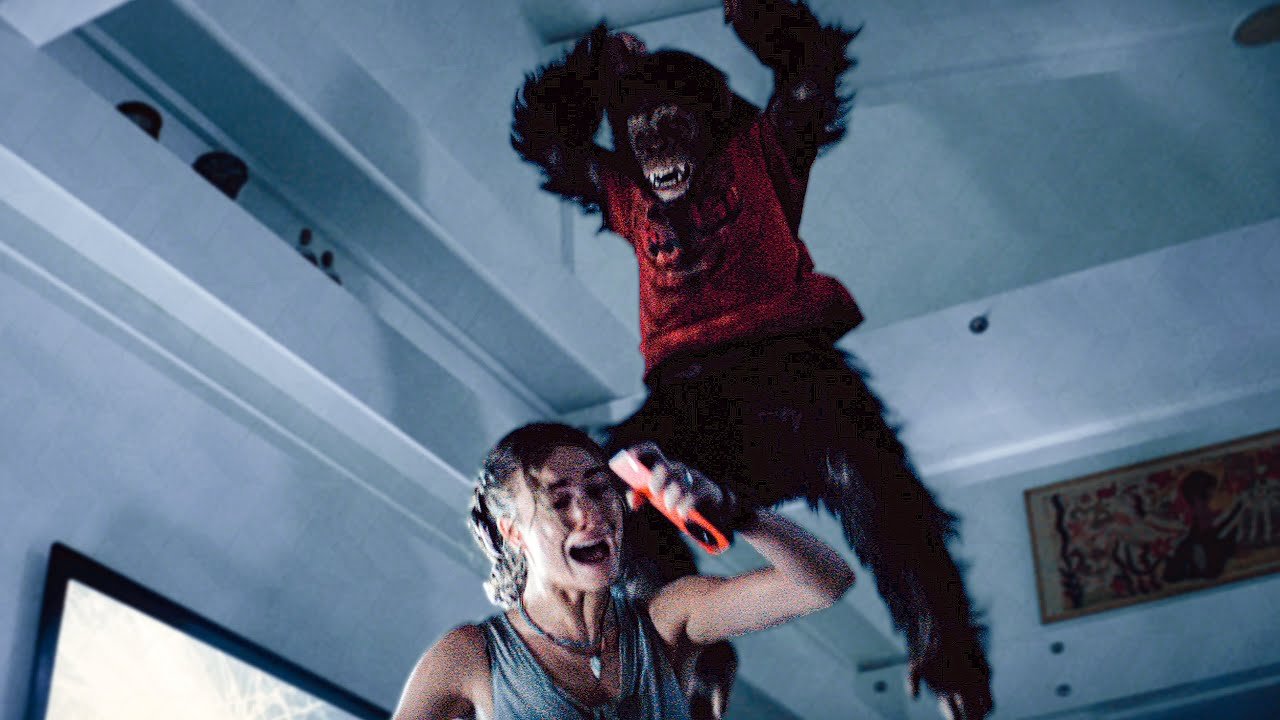
There is something inherently frightening about putting an intelligent animal in a horror movie. Johannes Roberts’ Primate takes that fear and builds it around a chimpanzee whose intelligence makes its transformation into a threat far more complicated than a typical creature feature.
The film follows Lucy, a college student who returns to her family’s secluded Hawaiian home with a group of friends. There, she reunites with her deaf father Adam, her younger sister Erin, and Ben, an intelligent chimpanzee adopted by the family and taught to communicate through a sound keypad by Lucy’s late anthropologist mother.
Ben initially feels less like a horror-movie threat and more like another member of the family. That changes after a rabid mongoose bites him while he is in his enclosure. With Adam away on a book tour and the rest of the family unaware of how quickly Ben’s condition is deteriorating, the situation begins to spiral.
Once Ben escapes, the family’s beautiful cliffside home becomes a trap. His intelligence makes him particularly dangerous because he understands the house, recognizes the people inside it, and can interact with his surroundings in ways a typical animal could not. What begins as concern for a sick family pet gradually becomes a fight to survive.
The most interesting aspect of Primate is that Ben is not presented as a simple monster. The film spends enough time establishing his relationship with the family to make his transformation genuinely sad. His attempts to communicate become increasingly difficult as the illness takes hold, creating a tragedy underneath the more conventional animal-attack horror.
What Works ✅
Ben’s Tragic Transformation: The physical performance behind Ben gives the character a surprising amount of personality. Early scenes establish him as intelligent, affectionate, and deeply connected to the family, which makes his gradual deterioration more upsetting.
That emotional foundation gives the film something many creature features lack. Ben is not simply an animal that needs to be stopped. He is a familiar presence who has become dangerous through circumstances beyond his control.
The Infinity Pool Sequence: The film makes excellent use of its central location, particularly the large infinity pool. The setting creates a simple but effective problem: the characters have limited places to go, while Ben controls the surrounding space.
The sequence works because it turns an otherwise luxurious location into a place of isolation. The characters are exposed, the escape routes are limited, and Ben’s intelligence makes every attempt to reach safety more difficult.
The Practical Creature Work: Primate understands that its central attraction needs to feel physical. The creature work gives Ben enough presence to make his movements and behavior convincing, while the practical effects help the attacks feel immediate without relying entirely on digital effects.
The film also earns its darker moments by spending time establishing Ben before the violence begins. That contrast makes his transformation more effective.
An Intelligent Threat: Ben’s intelligence is one of the film’s strongest ideas. He knows the house, recognizes the people around him, and understands how to interact with his environment.
That makes the threat more unpredictable than a standard animal attack. The characters cannot simply assume that Ben will behave like a wild animal because he has spent much of his life learning from humans.
Where It Falls Short ❌
The Supporting Characters Feel Thin: Lucy and her family receive considerably more attention than her college friends, who mostly exist to populate the house and increase the tension once Ben becomes dangerous.
Some of their decisions also feel more convenient for the story than believable for the characters. Horror movies can certainly rely on bad decisions, but Primate occasionally pushes that convention a little too far.
The Opening Gives Away Too Much: The film begins with a flash-forward before returning to the events that led there. While the structure creates some immediate curiosity, it also reveals information that would have been more effective if the audience discovered it naturally, because the first act is built around watching Ben’s condition change, showing part of that progression early takes away some of the mystery.
The Family Drama Could Go Further: The relationship between Ben, Lucy, and the rest of the family gives Primate its emotional foundation, but some of those ideas could have been explored more deeply.
The film clearly wants the audience to see Ben as both a beloved family member and an increasingly dangerous animal. That tension is effective, but the human relationships surrounding him sometimes feel like they are there primarily to support the horror rather than exist as fully developed conflicts of their own.
⚖️ Final Verdict: 3/5
Primate is a surprisingly emotional animal-attack horror movie that gets more mileage out of its central chimpanzee than the premise initially suggests. Johannes Roberts combines a contained setting, practical creature work, and a sympathetic setup to make Ben’s transformation more tragic than expected.
The thin supporting characters and unnecessary flash-forward hold the film back, but the central idea remains effective. Primate works best when it remembers that the scariest part of Ben is not simply that he has become dangerous. It is that the people around him remember who he used to be.
