


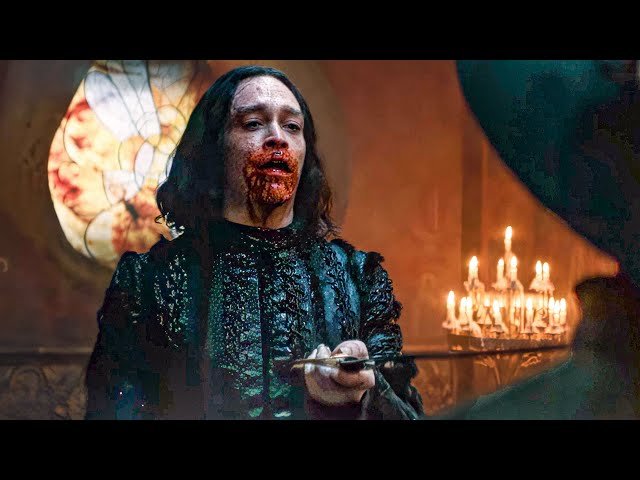
Over the years, Dracula has remained one of horror’s most recognisable figures, inspiring several memorable films that have given the legendary vampire different identities. From the monster-filled adventure of Van Helsing (2004) to the tragic origin story explored in Dracula Untold (2014), filmmakers have continued to find new ways to revisit the character. However, matching the impact of these modern interpretations is no easy task. Luc Besson now offers his own take on the legend, shifting the focus from Dracula’s bloodlust to the heartbreak and obsession behind his immortality. Starring Caleb Landry Jones, Dracula (2025) is a visually ambitious Gothic romance, but does its fresh perspective give the familiar story enough emotional depth?
The film begins in 15th-century Eastern Europe, where Prince Vladimir (Jones) loses his wife, Elisabeta (Zoë Bleu), during a war. Devastated, he renounces God and is cursed with eternal life. Centuries later, now known as Dracula, he continues searching for his wife’s reincarnation. His quest leads him to Mina (also Bleu), a young woman engaged to Jonathan Harker (Ewens Abid). As Dracula tries to reach her, he attracts the attention of a priest (Christoph Waltz), who is determined to stop him. Matilda De Angelis also appears as Maria, one of the figures in Dracula’s world.
What Works ✅
A Different Take on Dracula: Besson’s decision to approach the Count as a grieving romantic figure gives the film a clear identity. Rather than making his thirst for blood the main focus, the story examines the loss that drives him and the centuries he spends trying to recover what he believes was taken from him. Immortality becomes a punishment rather than a gift, and the contrast between Dracula’s endless life and his inability to move beyond one loss is compelling. It is a worthwhile direction for a familiar story, even if the film does not explore every part of it deeply.
Caleb Landry Jones’ Unusual Performance: Jones brings an eccentric quality to Dracula that separates him from more imposing interpretations. His physical mannerisms and unusual delivery fit Besson’s heightened approach. He is not simply playing a frightening vampire; he portrays someone whose grief has shaped his existence. The performance is deliberately theatrical, but it gives this version of Dracula a distinct personality.
Gothic Design and Music: The film makes a strong impression through its costumes, elaborate settings, and colourful presentation of 19th-century Paris. Its visual style moves between dark castles, grand interiors, and lively public celebrations while maintaining a period-fantasy atmosphere. Danny Elfman’s score supports the romantic and supernatural elements, adding scale to the dramatic moments. These craft choices are among the film’s most consistent strengths.
Christoph Waltz Adds Energy: As the priest pursuing Dracula, Waltz brings dry humour and a sharp presence to the story. His scenes contrast with Jones’ more exaggerated performance, and their conflict gives the film a clear opposing force. Although the role could have been developed further, Waltz makes the character engaging whenever he appears.
Where It Falls Short ❌
An Uneven Mix of Romance, Horror, and Comedy: Besson moves between tragic romance, vampire horror, and broad comedy, but the transitions do not always feel natural. Some humorous scenes interrupt the tension, while the frightening moments lack the weight needed to balance the film’s romantic ambitions. The story struggles to settle on a consistent tone. Besson’s playful approach may work for viewers who enjoy camp, but it weakens the atmosphere when the film asks the audience to take its tragedy seriously.
A Romance That Needs More Depth: Dracula’s search for Elisabeta’s reincarnation should give the film its emotional pull, but Mina is not always developed beyond her connection to the woman he lost. The story raises an interesting question about whether Dracula loves Mina for who she is or because she reminds him of his past. However, it does not give that conflict enough attention. As a result, the relationship feels more like an extension of Dracula’s obsession than a romance built between two fully realised characters.
Visual Spectacle Cannot Fix the Story: The production is full of striking images, elaborate costumes, and stylised effects, but the screenplay does not make equally strong use of its ideas. The passage of time should reveal how Dracula changes, or fails to change, but some historical detours feel more decorative than meaningful. Supporting characters also have limited room to develop, making the emotional conflicts feel thinner than the lavish presentation suggests.
Verdict: 2.5/5
Luc Besson’s Dracula has an interesting idea at its centre: an immortal vampire tormented by the loss of the woman he loved. Caleb Landry Jones gives the Count an unusual presence, while the Gothic design and Danny Elfman’s score provide plenty to admire.
However, the film struggles to make its romance convincing, gives Mina too little room beyond Dracula’s fixation, and shifts between horror, comedy, and melodrama without finding a steady balance. It offers a visually rich variation on a familiar legend, but its spectacle is stronger than its storytelling. At 2.5/5, Dracula is an ambitious reimagining with flashes of appeal, though it falls short of the classics it hopes to join.
